


I keep getting messages asking if my fund is okay.
Turns out there’s another company with “Blue” in the name. Blue Owl Capital. $300 billion under management. Publicly traded on the NYSE.
They locked investors out of a $1.6 billion fund and told them capital would be returned on an unspecified timeline, if returned at all.
Blue Eyed Capital. Considerably less than $300 billion. And just processed its Debt Fund distributions 15 days ahead of schedule.
We are not the same company.
But the mix-up forced a conversation I’ve been meaning to have. The confusion between Blue Owl and Blue Eyed Capital is the same confusion most investors have about the entire asset class. They hear “private credit” and “private debt” and assume it’s the same thing.
It’s not. And that difference matters more than almost anything in your portfolio when things get difficult.
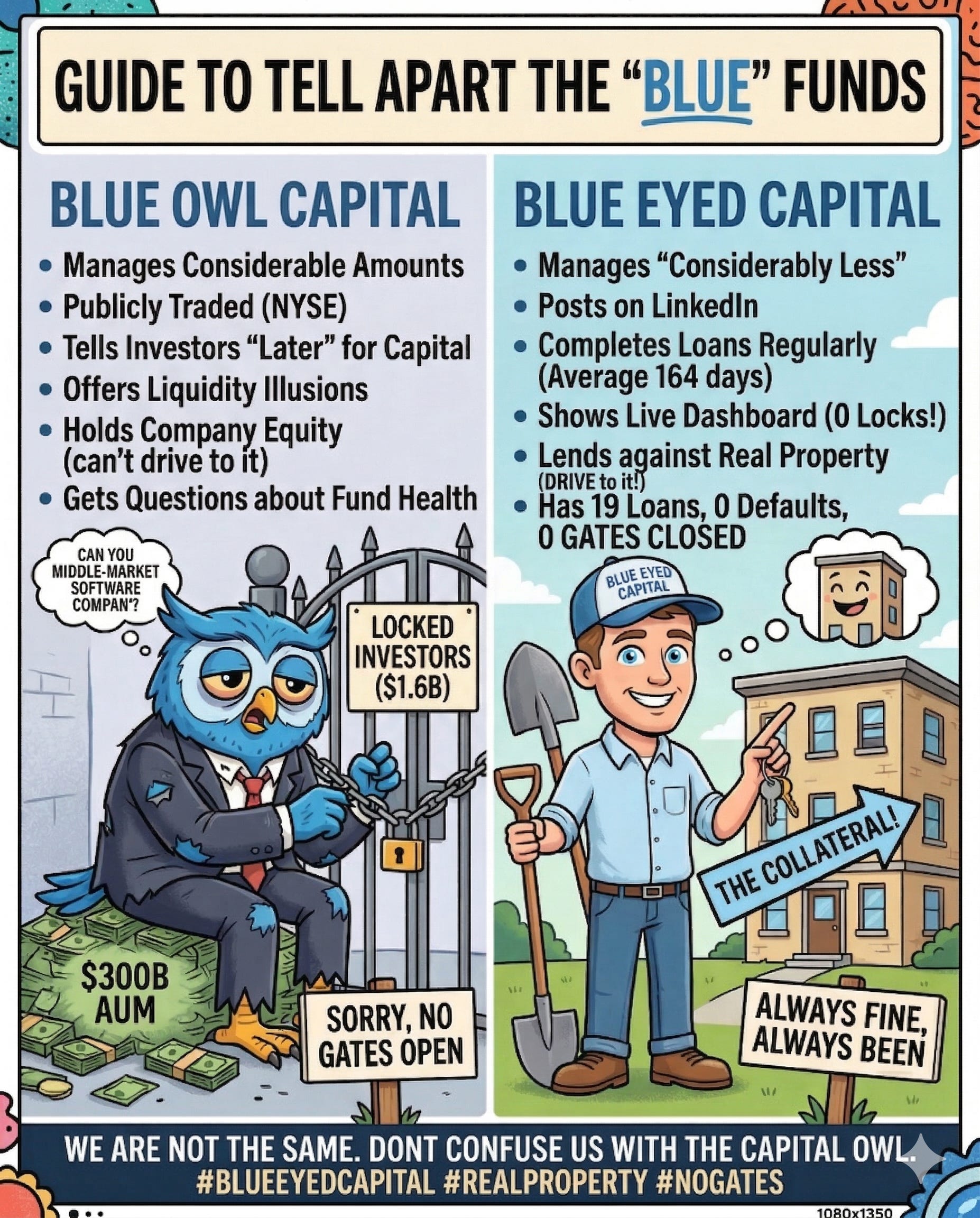
The Reality: Private credit and private debt are two different instruments with two different risk profiles. Most investors couldn’t explain the difference right now.
But here’s what makes that dangerous. When everything’s working, they look identical. Both generate yield. Both sit outside public markets.
The difference only shows when something breaks. And by then, it’s too late.
Private credit is lending to companies. Middle market businesses. Software firms. The collateral is often the company itself — its equity, its revenue stream, its future value. A business that might need a merger to exit. A business whose value depends on variables nobody controls.
Private debt secured by real assets is a different animal. The collateral is physical. A building. A property you can drive to, walk through, and touch.
If the borrower doesn’t pay, you own real property. And real property has a buyer. Always.
That distinction sounds academic until a fund locks its gates.
🏠 Interested in starting or growing your real estate portfolio? Join a community of changemakers investing to build wealth and create impact.
Blue Owl’s investors thought they had liquidity. They thought the yield meant the risk was managed. What they had was exposure to companies whose exits depend on conditions nobody promised.
Short-duration private debt works differently. When a loan averages 164 days, capital isn’t locked for years. It recycles. Money goes out, a project completes, the borrower refinances or sells, and the money comes back. No gate. No unspecified timeline.
The collateral question is the one most investors never ask. When someone offers you yield, the first question shouldn’t be “how much.”
It should be “secured by what.”
Yield is easy to promise. Collateral is what pays you back when a promise is broken.
A building doesn’t need a merger to return capital. It doesn’t need a Series C round. It needs a buyer. And buildings with tenants paying rent always have buyers.
Private credit and private debt use similar language. Financial advisors sometimes use the terms interchangeably. But the risk you’re taking, the collateral behind it, and what happens when things go sideways are fundamentally different.
The Bottom Line: Yield without collateral is a promise. Yield with real assets behind it is a structure. Most investors hear “private” and assume the risk is the same. You’re learning to ask what’s behind the return. That’s the difference between chasing yield and understanding where it comes from.
Next time someone offers you a private lending opportunity, ask one question: Can I drive to the collateral?
If you want to understand how private debt differs from private credit in practice, I’m happy to walk through it. Just reply to this message, and we’ll set up a call.
Cheers,
Jon