


There is this claim in the building world that a dollar of maintenance you defer becomes four dollars later. In all my years it was never that simple so I went looking for a study. What I found was worse than an actual study.
The trail ended at a blog post on a vendor’s website. The rule is credited to Rick Biedenweg, who was at Stanford and did publish. So I read what he published. The National Academies describe his model. It says one-to-one.
The industry quadrupled his number and kept his name on it.
That took an afternoon. What took longer was what came after, because I still had to tell somebody what to budget.
Knocking it down is the easy half. Anybody with a library card can do it. The hard half is that the number was load bearing. It held up every argument for spending money on a building before the building forces you to, and when you pull it out, the argument is standing on nothing.
So this issue is the other half. Not what is wrong with the number, but what to use instead, on Monday, in front of somebody who wants a reason.
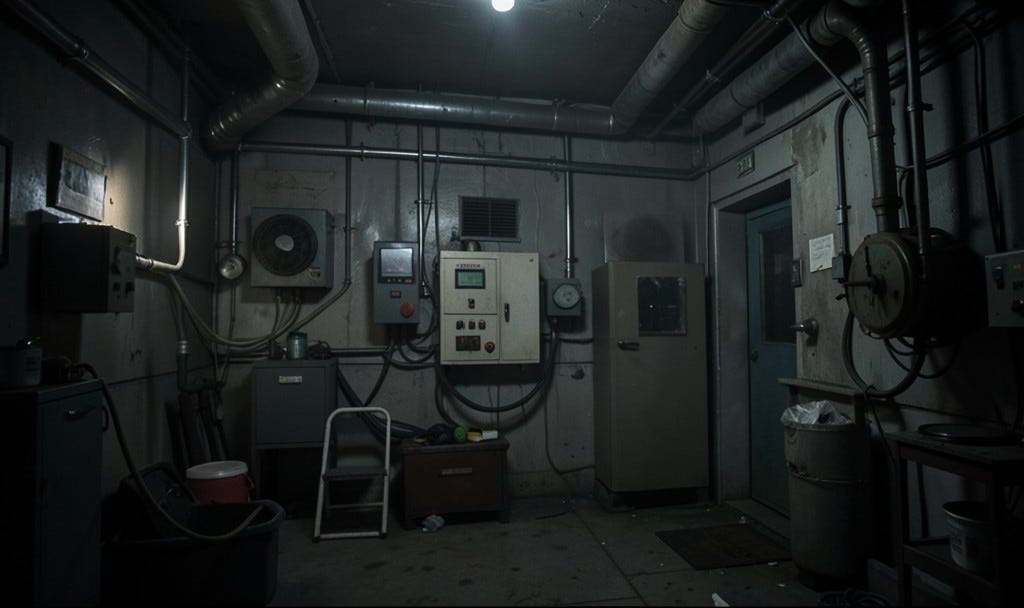
The Reality:
There is no multiplier because nobody ever built the dataset that would produce one.
That is not my opinion. In 2012 the National Research Council reported that this field lacks dependable models connecting maintenance spending to what happens to a building. The research everyone assumes exists was never done, and the number circulating in its place is sitting in the hole where it should be.
The deeper problem with the four is not that it is unsourced. It is the wrong shape of answer.
A multiplier says the repair grows. It says the thing that cost a thousand dollars this year costs four thousand in three, as though the work were inflating in a jar somewhere.
That is not what happens. A pump is a pump. A compressor is a compressor. What grows is everything around the repair, and all of it comes from one thing: you no longer choose when it happens.
Deferred maintenance is not a growth curve. It is the price of losing control of the calendar.
🏠 Interested in starting or growing your real estate portfolio? Join a community of changemakers investing to build wealth and create impact.
Heating fails in January, not September, because January is when it is being asked to work. So you are replacing heating in midwinter, with frozen pipes on the table and angry people on the table, and codes require you to hold a minimum temperature. Fail and a resident calls the city. Now you have an inspection, a file, and a reputation attached to a repair that would have been routine in the fall.
None of that is the repair getting more expensive. It is the repair arriving with company.
And a third thing you lose shows up in no budget line anywhere. You lose the scope.
When you schedule a replacement, you decide what is included. Whether the valves come too, whether the controls come with it, whether you fix something that has annoyed you for two years. When the failure schedules it, the failure decides. You buy exactly what is required to get running again, and everything you would have bundled with it stays undone and comes back later as its own emergency.
Planned work is a purchase. Emergency work is a ransom.
I will not hand you a multiplier for that either. Nobody has measured it across buildings, and I will not invent one to make my case.
The two numbers I will stand behind.
Neither of them is mine.
The first is from the National Research Council, published in 1990 and carried by APPA since. Budget two to four percent of what it would cost to replace that building today, every year, covering routine operations and long-cycle renewal. It is the best-sourced benchmark this field has, and it is a budget floor, not a multiplier.
The second is from the Department of Energy. Planned maintenance runs roughly twelve to eighteen percent cheaper than running to failure.
Look at the size of that. Not three hundred percent. Not four hundred.
The honest version is less exciting than the one being quoted, which is exactly why the invented number spread. Twelve to eighteen percent does not win a room. Four to one wins a room. And the cost of winning a room with a number you cannot source: the day somebody asks where it came from, you lose the argument you were right about. Not the number. The whole case.
Then run the test on your own books.
Compare what you spend on repairs against what you spend on capital. If repairs are beating CapEx, you are not doing it right.
That is the whole test. Both numbers are already booked. No estimating exercise, no consultant, no survey.
What makes it useful is running it per system, not per building. A building-wide ratio says the property is unhealthy. A system-level ratio says which system, and that is an instruction.
Pull your last thirty-six months and sort the spend by system. Heating and cooling. Plumbing. Electrical. Roof and envelope. Site and drainage. Then put repairs next to capital for each.
The system where repairs have quietly passed capital is one you are already replacing, a thousand dollars at a time, on the equipment’s schedule instead of yours. That is your next capital project, and you can say why in one line.
Then use the two to four percent as the sanity check. If you are at half a percent, you are not running a maintenance program. You are running a deferral schedule and hoping the sale closes first.
One caveat, and I mean it. A water heater in a mechanical room with a drain is a different decision than the same heater in a unit closet above someone’s living room. Context is not an excuse. Context is the job.
The bottom line.
A number you cannot source is one somebody can take away from you, usually in the exact meeting where you needed it most.
The cost of deferred maintenance is real. I have watched it. I just cannot tell you it is four, because the moment I do, I am the vendor blog.
What I can tell you is two sourced figures and a test you can run on your own books before lunch. That is a smaller claim. It is also the one that survives being questioned, which is the only property a number really needs.
Use the small true one. It will still be standing when the meeting is over.
—Jon
P.S. If somebody in your next budget meeting is about to quote the four to one rule, forward this to them first. Better to hear it from you than from the person across the table.