


There is water coming through the ceiling of my own unit right now. I am a licensed professional engineer, twenty years and four states. I am on the ground floor, and the roof sits directly above me. A roof inspection was already booked for next month.
I have not been on that roof. I do not know where the water is getting in. What I have is a ceiling, and a ceiling is a document. Here is how to read one.
Start with the space nobody pictures. Between the underside of a roof and the top of your ceiling there is a gap, and every building has one. Framing runs through it, and so do pipes, wires, ducts and insulation. Water that gets past a roof does not fall into your room. It lands in that gap first, then it travels, and your room is the last stop rather than the first. That one fact is why a stain is almost never in the right place.
The shape.
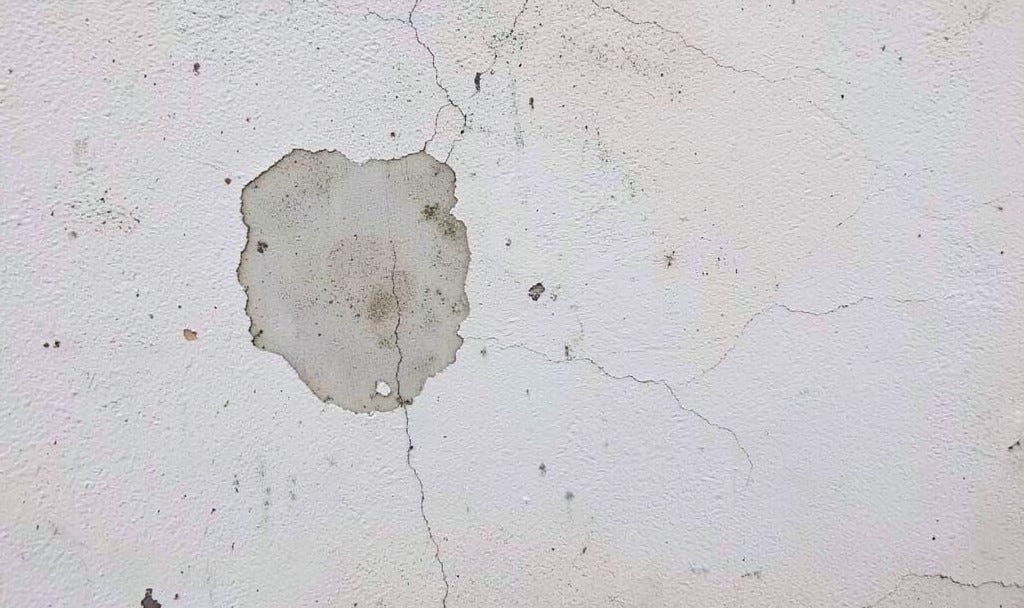
A round mark means water arrived somewhere and stopped there. A line means it was following something. A right angle means it met something that was built, because nothing in nature turns a square corner.
Mine comes out along a line with a branch that turns ninety degrees. That is a record of framing, or a seam, or whatever was lying up there. It is a map of the last few feet, not a map of the first few.
Water in that gap is not falling, it is being carried. It runs along the top of whatever it landed on and goes where that surface slopes, which has nothing to do with the slope of your ceiling. That is how a hole ends up far away from the stain. It is also how a hole ends up higher than the stain.
The color.
Clean water falls clear, because it has touched nothing. Mine is amber, which means it spent time against something and took the color out of it on the way down. Color tells you there was a journey. It does not tell you where the journey started.
The edges.
🏠 Interested in starting or growing your real estate portfolio? Join a community of changemakers investing to build wealth and create impact.
Water wets an area, stops, and dries at the boundary, and it leaves a ring where it stopped. One ring is one event. Rings inside rings mean it happened more than once, and somebody decided it was finished before it was.
The timing, which is the one nobody checks.
Everything above reads the path. The timing reads the source, and it is the test nobody runs.
Answer one question in three parts. Does it get worse while it is actually raining, does it appear hours after the rain has stopped, or does it happen in a week with no weather at all?
Water that arrives with the rain and stops when the rain stops is coming from outside, and it is coming through something that opens straight to the sky. A roof, a wall, a window, or something that penetrates one of them.
Water that shows up after the sky has cleared is still coming from outside, through something that holds water first. A blocked drain that has to fill before it spills. A low spot that ponds and then finds a seam. Insulation that soaks like a sponge and releases for two days. That lag is not a mystery. The lag is the storage.
And water that appears in a dry week is not weather at all. That is a pipe, a fitting, or condensation forming on something cold. That fork is the difference between calling a roofer and calling a plumber, answered by a calendar, not by opening anything.
Mine has not run that test. I will know more next time it rains.
What else is up there.
Then look at what else is mounted in that same plane. Smoke detectors go on ceilings because smoke rises, so the ceiling is where you find out first. Sprinkler heads go up there for the same reason, because heat collects at the top of a room. So the ceiling is the surface we chose for the two devices that only matter on the worst day of a building’s life. It is also the surface water has to cross to get out.
In my unit a smoke detector sits inches from the wet line, and there is a sprinkler head on the same ceiling. I am not telling you those have failed, because I do not know that. I am telling you that an electrical device standing in the path of water is a condition, and that nobody has checked it.
When you find a stain, do not only look at the stain. Look at what shares the ceiling with it.
What to do before it dries.
A stain is evidence, and evidence evaporates. Before it dries, photograph it with something in the frame for scale, and run a pencil line around the wet edge. The next time it goes wet you will know in one glance whether it grew and by how much. That is the difference between an event and a progression.
When somebody finally does get up there, give them one instruction. Start above the stain and work uphill from it, not outward from it. And look at the penetrations first, the vents, the drains, the curbs, the flashing, anything that comes up through the surface, because the open field of a roof is rarely where it fails. It fails where something interrupts it, and every interruption was installed by a person.
The inspection is still next month. Until then I have a complete report on this leak, and it is written in the one place the leak is not.
A ceiling is the bottom of the space above it. Whatever happens up there arrives down here eventually, late, and in the wrong spot. That is not the building failing to tell you. That is the building telling you the only way it can.
—Jon