


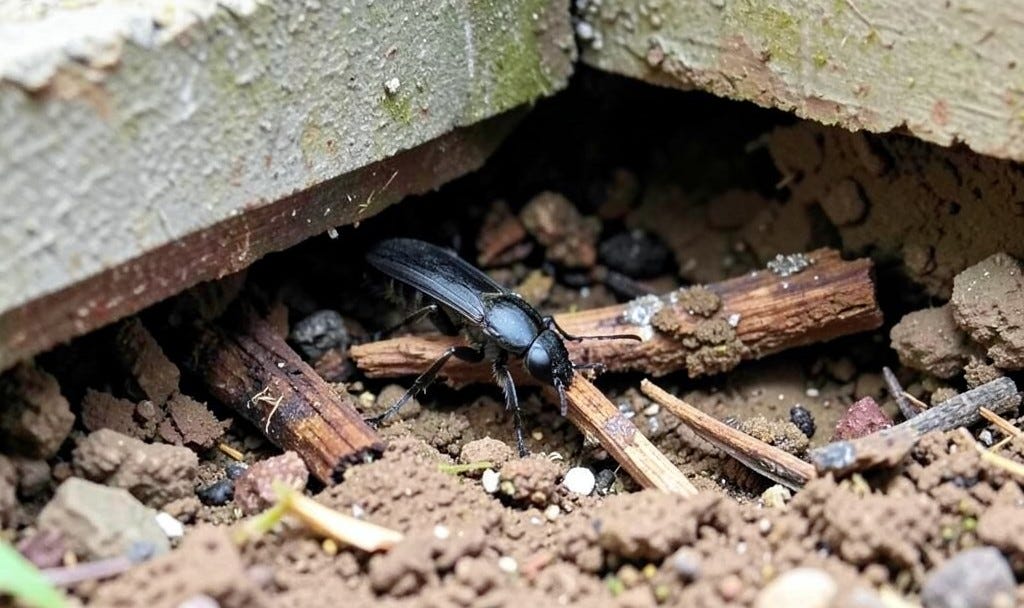
There is an insect that lives in the dirt under buildings and eats wood. It works from inside the board, hollowing it along the grain and leaving the painted face alone, so the wood looks perfect right up until it is a shell.
You are not going to see one. It has no reason to come where you are. So the whole job is finding the things it leaves behind, and there are three of them, and all three are easy once you know.
Mud in a place mud should not be.
These insects dry out in open air. That is their one limitation. They need the damp of the soil against them to stay alive. So when they have to cross something they cannot eat through, a concrete foundation wall, a block pier, a stone footing, they build a covered road out of soil and their own material and travel inside it.
That road is not a hiding place. It is a piece of the ground, carried up the wall, so they can take the wet part with them. It looks like a thin line of dried mud running straight up concrete, in a spot where nothing should be growing at all.
Go walk your foundation. Look low, and look behind the shrubs.
Wings.
When a colony gets big enough, part of it grows wings and leaves to go start another colony somewhere else. They fly a short distance, they land, and they shed the wings, because they are never going to need them again.
So you find a small pile of identical wings that nobody flew away in. On a windowsill, in a light fixture, in a spider web beside a door. The insects are long gone and the wings are still there. A pile of them inside a building means a colony matured close enough to reach it.
Sound.
🏠 Interested in starting or growing your real estate portfolio? Join a community of changemakers investing to build wealth and create impact.
Solid wood gives a dull, dead note when you knock on it. Wood that has been hollowed gives a lighter one, papery and wrong, and you can hear the difference with no training at all.
Then there is a probe, which is a screwdriver. Push it into the bottom of a stud, into a sill plate, into the wood down in a crawlspace, somewhere nobody is going to look at the mark again. Solid wood stops it. Hollowed wood takes the face and then gives way underneath. That is the test. It costs nothing and it takes an afternoon.
What those three have in common.
Mud, wings and an empty space. Waste, packaging, and the hole where the wood used to be. All three are discards, and that is the rule for this entire category, not only termites.
Carpenter ants do not eat wood at all. They chew it out to build a nest and push the shavings through a hole, so you find a small pile of what looks like sawdust on the floor below. Powderpost beetles leave round exit holes and a fine powder. Different insect every time, same principle every time. You never find the animal. You find what it threw away.
The part you actually control.
Finding them is the reactive half. The other half is that most of what invites them in is a maintenance decision somebody made, and every one of those decisions is reversible.
They need three things: wood, moisture, and a way from the soil to the wood. You cannot do much about the wood, because the wood is the building. You can do a great deal about the other two, and it is all ordinary groundskeeping.
Look for anywhere wood touches soil directly, because that is a bridge with no tunnel required. Deck posts set into the dirt. A fence rail that dies into the siding. Lattice buried at the bottom. Then look at what is holding water against the building: mulch piled up over the siding line, a flower bed graded toward the wall, a downspout dumping at the foundation instead of away from it, an irrigation head spraying the wall every morning at six.
None of that is an insect problem. All of it is a water problem that an insect will use. And every item on that list gets fixed by a person with a shovel in an afternoon, which is why it is worth knowing before it becomes a framing repair.
Who is supposed to be looking.
A standard property inspection is visual and it is not invasive. Wood destroying insects sit outside its scope. That is a separate inspection, ordered separately, and it is a person on their knees with a flashlight and a probe, out along the sill and down in the crawlspace, in the part of the building nobody has ever been in.
Nobody skips it on purpose. It is the one line on the page that nobody can picture, so it is the one that comes off.
And if you are buying, ask for two documents rather than one. Ask for the inspection, and ask for the treatment history: what was applied, when, by whom, and whether anything is still under warranty. A building with a long treatment record is not a worse building. It is a building where somebody was paying attention, and you now know exactly where it has been vulnerable before.
Go look this week. You are looking for mud that has no business being there, wings that nobody flew away in, and a board that sounds wrong when you knock on it.
Everything they do is invisible. Everything they throw away is not.
—Jon