


Glass is probably the least efficient building material on planet earth.
I have said that in a few rooms and watched a few architects flinch. It is still true. Glass has terrible thermal performance. It moves heat in and out of a building like a screen door. It has weight problems. It has labor problems. Every joint is a future failure point.
And Apple loved it. Apple still loves it. The brief on every flagship store I worked on for nine years opened with some version of the same idea — the building has to feel like glass, like air, like the product is floating in light.
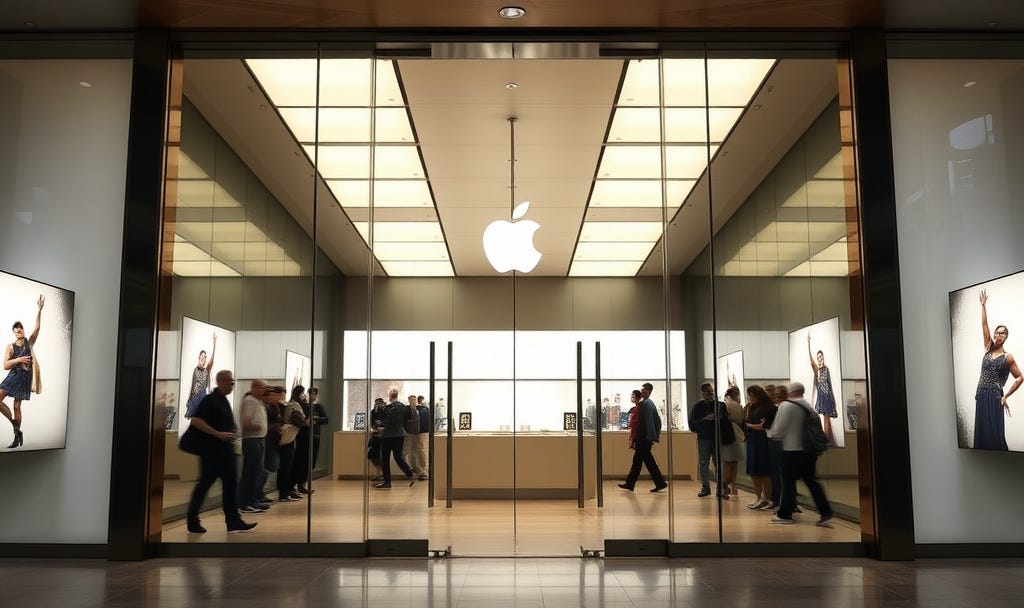
My job inside that brief was to make the building actually perform. To make it stay cool in Dubai. To stay warm in Brussels. To not condensate in Shanghai. To not blind a customer in Sydney at three in the afternoon. To not load a structural team with weight they could not justify.
We couldn’t fight the constraint. Glass was not going away. That was the religion. My job was to engineer around the religion.
Most of that work nobody ever sees. Custom fabric ducting behind a video wall so the cooled air dropped into the room exactly where customer bodies stood, but never blew across the merchandise. Tinted interlayers that you could not see were there. Frit patterns at the top of the pane that broke the worst of the solar load while leaving the bottom four feet clear so the storefront still read like glass. Thermal breaks inside the mullions you would never notice unless you were looking for them.
Most of it shipped. Some of it did not.
The ones that did not ship are the ones I want to tell you about today, because they are what I think about whenever I am underwriting a deal.
There was a sliding glass system we built three times. Worldwide largest in retail. The first set took three minutes to traverse twenty feet. That is too slow. A customer at a storefront does not wait three minutes. So we went back. The second set was faster. Not fast enough. We went back again. The third set was forty-five seconds.
We did not ship the version that took three minutes. We did not put it in the store and tell ourselves the customer would adapt. We did not say good enough. The decision in the room was the same decision every time. If it is not right, it does not go.
🏠 Interested in starting or growing your real estate portfolio? Join a community of changemakers investing to build wealth and create impact.
That sounds nice on a stage. It is brutal in practice. It means somebody on a fixed budget and a fixed opening date is going to lose. Somebody is going to have to tell their team the work they did for six months is not going in. Somebody is going to have to explain to finance why the line is over. Somebody is going to have to absorb the schedule. Sometimes that somebody was me.
It also means the building that finally opens is the one that the customer experiences. Not the one we hoped the customer would experience.
Apple gets called a lot of things. The thing it gets called least is patient. From the outside it looks like everything happens fast and everything is polished. From the inside it is mostly people who refuse to ship the thing that is not right, and pay for that refusal in real money and real careers.
Here is why I am still talking about it nine years later.
When I underwrite a loan now, the most important question is not the rate. It is not the term. It is the version question. Which version of this deal am I being shown? Is this the first version that opened in three minutes, dressed up to look like the forty-five second version? Is this the version where somebody got tired and shipped what they had?
Most of the deals that go bad are not bad ideas. They are good ideas that shipped early. The operator ran out of capital. Or out of patience. Or out of the appetite to tell the truth about what was not working. And the version that closed was the version everybody had stopped fighting for.
I try, with mixed success, to ask the version question of myself. Of the borrowers I lend to. Of the buildings I walk. Is this the right version of this thing, or is this the version we got tired enough to call the right version.
The glass that was supposed to ship is rarely the glass that ships. The discipline is in noticing the difference before everybody else does, and being willing to pay for the gap.
—Jon
If this one landed, forward it to whoever you are about to ship something with. I think they will know what to do with it.