


Investing in real estate can be a powerful way to build wealth, but when it comes to private multifamily investments, many are left with questions.

Unlike traditional investment options like stocks, where understanding profit and loss is pretty straight forward, alternative real estate investment opportunities aren't typically covered in mainstream education or financial news.
The lack of information creates an exclusivity around alternative investments that shouldn't be. Many don’t try to access them because they require a willingness to learn and understand their unique structure and nuisances.
But you’re here, and it’s clear you have that willingness. We’ve tried to simplify the complicated because these investments are powerful and you should be using them.
Inside Scoop on Real Estate Profits
We're breaking down the fundamentals of how private real estate investments work:
The Structure of Private Real Estate Investments
Roles of Active and Passive Partners
How Profits Are Generated and Distributed
Turning Equity into Cash
The Structure of Private Real Estate Investment
At its core, a private multifamily investment involves multiple investors pooling their resources—capital, experience, and knowledge—to purchase a property together. This is referred to as a Syndication. This collaborative effort allows for the acquisition of larger, more valuable properties than any individual could manage alone. Here's how it works:
Formation of an LLC: Investors form a new LLC (Limited Liability Company) where all members hold an ownership stake.
Capital Contribution: Both active and passive partners contribute capital to the LLC.
Property Acquisition: The LLC uses the pooled capital to purchase a multifamily property, which it then manages and operates.
By partnering, these investors share both the risks and rewards of the investment, with profits distributed based on each partner's stake in the LLC.
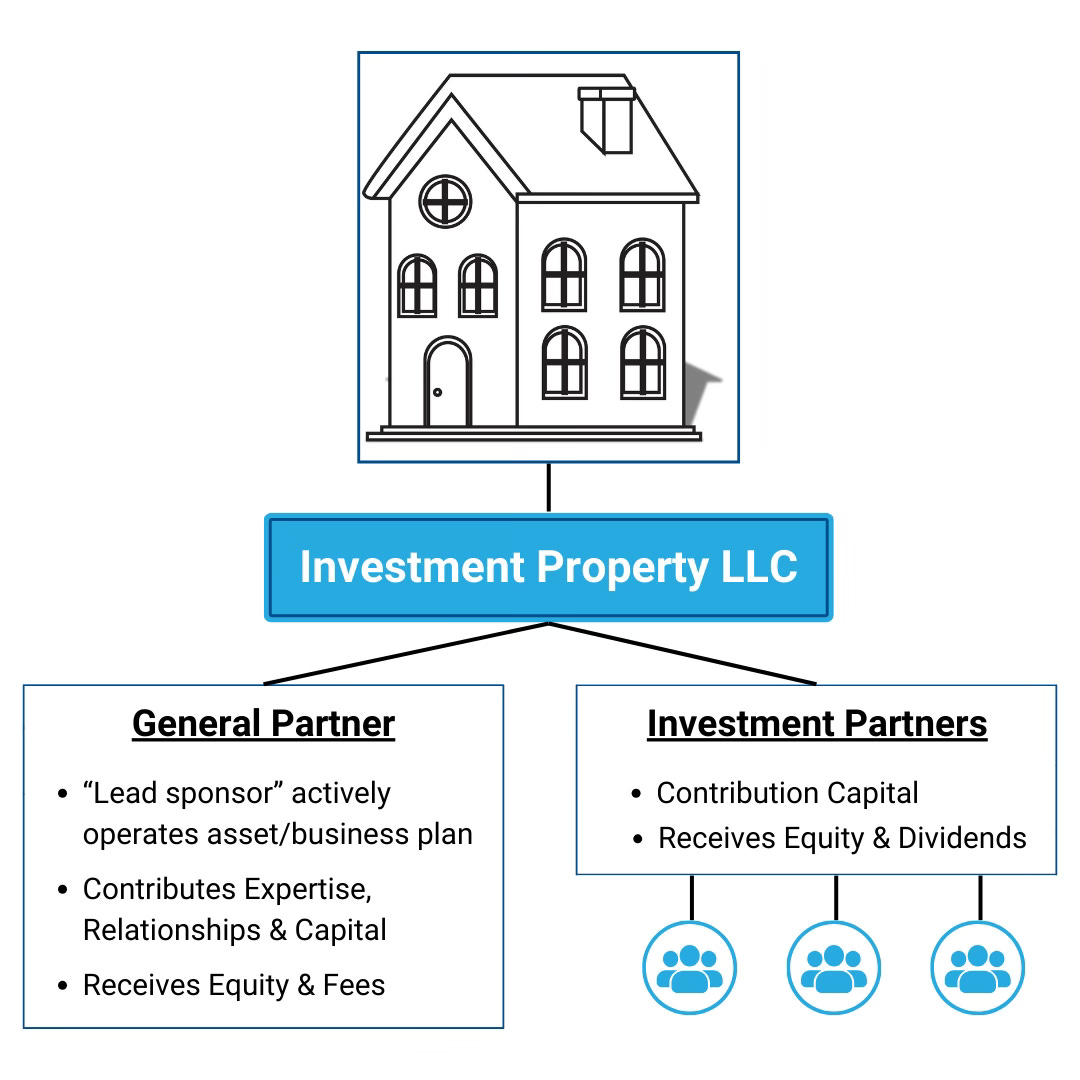
Roles of Active and Passive Partner
In a private real estate investment, there are two key roles:
Passive Investment Partners: These are individuals who contribute capital without participating in the day-to-day management. Their role and risk is limited to financial contributions, and in return, they receive a share of the profits based on their investment.
Active Partners: Active partners are responsible for managing the entire investment process. This includes finding and evaluating properties, conducting due diligence, securing financing, and overseeing property management. By taking on these responsibilities, active partners enable passive investors to benefit from real estate ownership without the associated workload.
🏠 Interested in starting or growing your real estate portfolio? Join a community of changemakers investing to build wealth and create impact.
How Profits Are Generated and Distributed
Profits in a private multifamily investment are generated through three primary avenues:
Net Cash Flow: This is the income remaining after all property expenses and loan payments have been made. It’s a direct source of cash that can be distributed regularly to investors.
Loan Pay Down: As the loan on the property is paid down, the equity in the property increases. This equity can be converted into cash through refinancing or the sale of the property.
Appreciation: Over time, as the property’s income increases (through higher rents or lower expenses), the property itself becomes more valuable. This appreciation boosts the equity that investors hold in the property.
These profits are distributed at varying times throughout the investment life cycle which can differ greatly from the typical stock investment whose profits are generated mainly on the sale of the stock.
Turning Equity into Cash
There are two primary ways to convert equity into cash for distribution:
Selling the Property: The simplest method is selling the property. The sale proceeds, after paying off the existing loan and covering any selling expenses, are distributed to the investors. Sale events and capital appreciation result in capital gains tax.
Very often the active partners will leave this out of their performance return projections, but it is important to consider.
Refinancing the Property: An alternative is refinancing the property. By taking out a new loan based on the increased equity, the difference between the new and old loan amounts (after costs) can be distributed to investors as cash.
This method packs a powerful punch as well, because a refinance event does not carry capital gains tax implications.
Changing interest rates in today’s markets can have a big influence on the viability of this approach.
Nothing good comes easy they say and that is true about Real Estate investing. It’s potential to grow your wealth, and create passive income, can be a valuable tool in one’s search for financial freedom.
But it takes work! Owning commercial real estate is owning a business, not just owning an asset, and the combination is where this alternative investment shines.
Jon
👉 If you enjoyed this, share it with a friend and consider subscribing.